
Diving the Deep South: A Red Sea Safari from Marsa Alam to St John's
The hot, dry desert air hit me the moment I stepped onto the tarmac at Marsa Alam, and the wind whipped my hair across my face. An hour earlier I had been in Cairo. Now I reallywas back in Egypt, and it felt good.
I’ve dived the northern Red Sea almost every year since 2005, but the Deep South had been on my wish list for a long time. I’d heard about pristine coral reefs, beautiful cave systems, dolphins, sharks and dugongs. This liveaboard to St John’s and Fury Shoal, just above the Sudanese border, was my chance to find out whether the rave reviews were true.
Boarding in Port Ghalib
At the airport, we loaded our luggage onto the bus in true Egyptian style – through the back window. A five-minute drive past half-finished resorts brought us to Port Ghalib marina, 65km north of Marsa Alam. According to its website, Kuwaiti billionaire Nasser El Kharafi poured two billion dollars into turning this stretch of empty coastline into the region’s largest tourist and marina complex.
On board, we were handed ice-cold juice in the air-conditioned salon, then went to choose our spots for our gear on the dive deck. One of my fellow guests had done his homework: avoid the wetsuits (they flap in your face while you kit up), avoid the main walkway (you’ll be swamped), and look at where the dive guides keep their gear, because that’s usually the best spot.


Easing in at Abu Dabab and Shaab Marsa Alam
Our checkout dive at Abu Dabab Talata began with a giant stride into soft, clear 28°C water. Pinnacles rose from a sandy floor, each coral bommie hosting its own community of dascyllus and chromis. Blue spotted stingrays rested on the sand while a giant moray and a bluefin trevally patrolled for breakfast. It was June, mating season, so the Picasso triggerfish were busy chasing each other around.
Then came Shaab Marsa Alam, and the biggest, most prolific coral garden I have seen in 17 years of diving the Red Sea. Coral stretched to the edge of visibility, with juvenile barracuda, goatfish and snappers hanging above it. I could have stayed there forever.
South to St John’s
The overnight crossing was one of the roughest I’ve experienced. Huge swells battered the boat and, at one point, sofas and their occupants slid across the deck. By 18h00 the wind dropped, and we reached St John’s at 06h00 the next morning.
Paradise reef opened with cracks, swim-throughs and light rays filtering down from the surface. A huge Napoleon wrasse swaggered past with his smaller Napoleon and a few bluefin trevally entourage, like a gangster followed by his minions. Then a school of bumphead parrotfish drifted by, looking like mischievous schoolboys. I was on my safety stop by then and had to watch from above, so no photo. Such is diving!

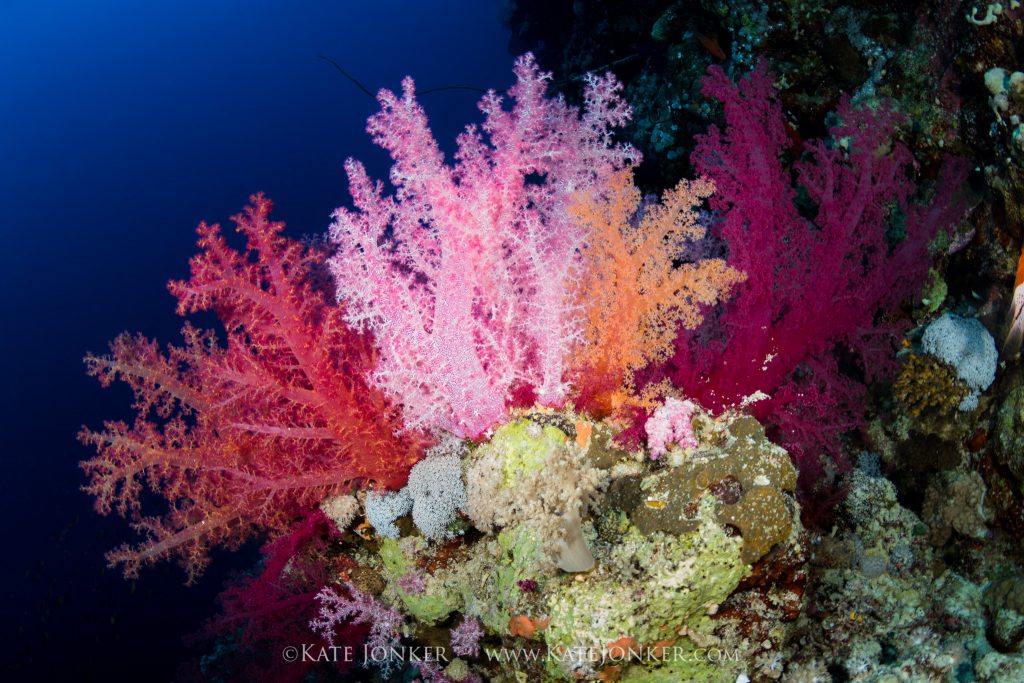
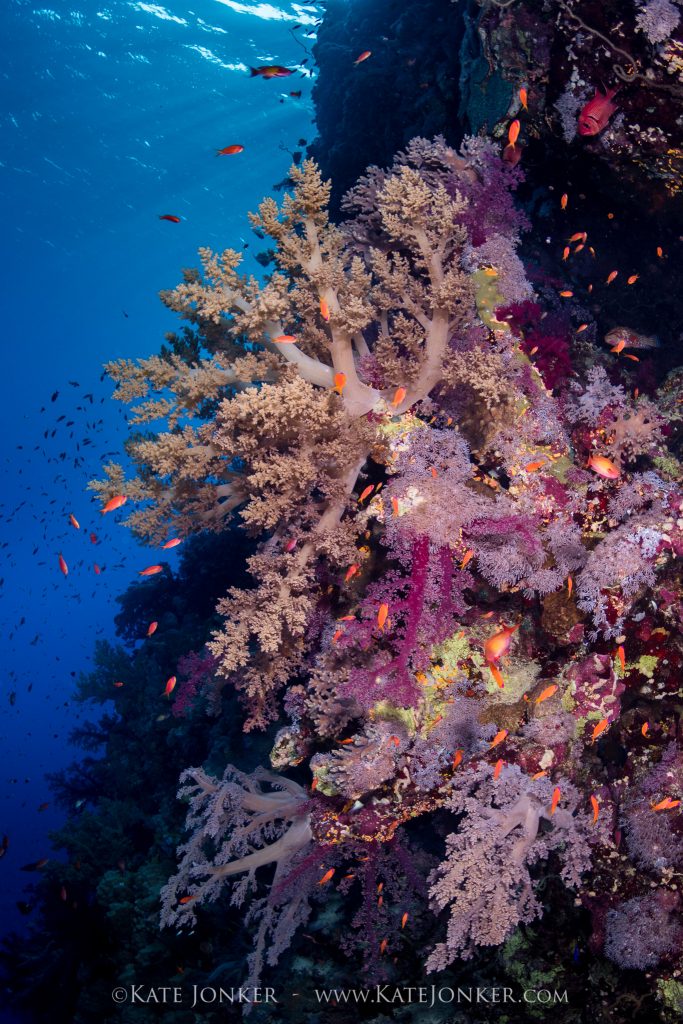
Habili Gafar may be one of the most beautiful walls I’ve ever dived. Pink, orange, red and purple thistle soft corals glowed against deep blue water that drops past 700 metres, with anthias hanging along the whole reef.
Habili Ali and Big St John’s gave us shark hunting. I spotted a grey reef shark first, but it was gone before I could give the “Look! Shark!” signal. The other group saw a scalloped hammerhead, a thresher and a whitetip. Both reefs reminded me of the Brothers Islands, with steep walls and paler broccoli soft coral.
St John’s Caves was one of the main reasons I’d come south, and it exceeded my expectations. I’d seen the photos of sunbeams cutting through the reef, but nothing prepared me for the light playing on the sandy floor. The maze-like system is shallow, which means long dives, and one dive is nowhere near enough. Inquisitive dolphins even joined us on our safety stop.
Parrotfish Heaven and a visit from an oceanic whitetip
At Sataya reef we found what I can only call “Parrotfish Heaven”. Indian longnose, ember, bullethead, redbreasted and steephead parrotfish were foraging, chasing and squabbling over territory everywhere I looked. Then my buddy Esther started shouting and pointing. An oceanic whitetip had emerged from the blue with its striped pilot fish, and it took a liking to Esther, circling her several times before drifting back to the depths. Aloof, beautiful and humbling.
Life by The Bell
There’s a saying on Red Sea liveaboards: if your hair is wet, it’s time to eat, and if it’s dry, it’s time to dive. Every boat has a large brass bell to remind you. Miss it and you’ll get a look of disapproval from the dive guide at the briefing, or a hurt look from the dining room steward if you’re not first in the food queue.
Days settled into a rhythm of diving, eating, resting, chatting and preparing cameras. Night dives were offered every evening, and we found Spanish dancers, stonefish, parrotfish sleeping in their mucous cocoons, basket stars feeding in the water column and masked puffers resting on the rocks.

Elphinstone and the dugong that wasn’t
Heading north overnight meant a strong headwind and a rough sea. By morning the wind was howling. Waves broke over the reef, and the boat bucked against its anchor lines like a wild stallion. We did a negative entry and swam along the plateau at 30m, and a scalloped hammerhead came face to face with us, flicked its tail and vanished.
Getting back on board was another story. The swells were huge, so we jumped off the zodiac and swam for the ladder, which was fully submerged one moment and clear of the water the next. I wasn’t scared of the ladder. I was scared of the oceanic whitetips circling the zodiac!
Conditions ruled out a second dive, so we went looking for dugongs at Marsa Shouna, the top item on my bucket list. In four metres of water I found juvenile fish hiding in the seagrass and shrimps sharing burrows with gobies, but no dugong. It was a poignant way to end the trip.
My verdict
The Deep South delivered everything I’d read about, and more. The coral gardens were pristine, the walls were covered in vibrant soft corals and the caves were breathtaking. The dolphins, turtles and sharks added a sparkle of magic.
If sharks are your priority, the Brothers, Daedalus and Elphinstone route is the better choice, and wreck lovers should look at a wreck itinerary. But if you want a change from the north, the Deep South won’t disappoint. I’m already planning my return – and perhaps next time I’ll see that elusive dugong.